Rural America

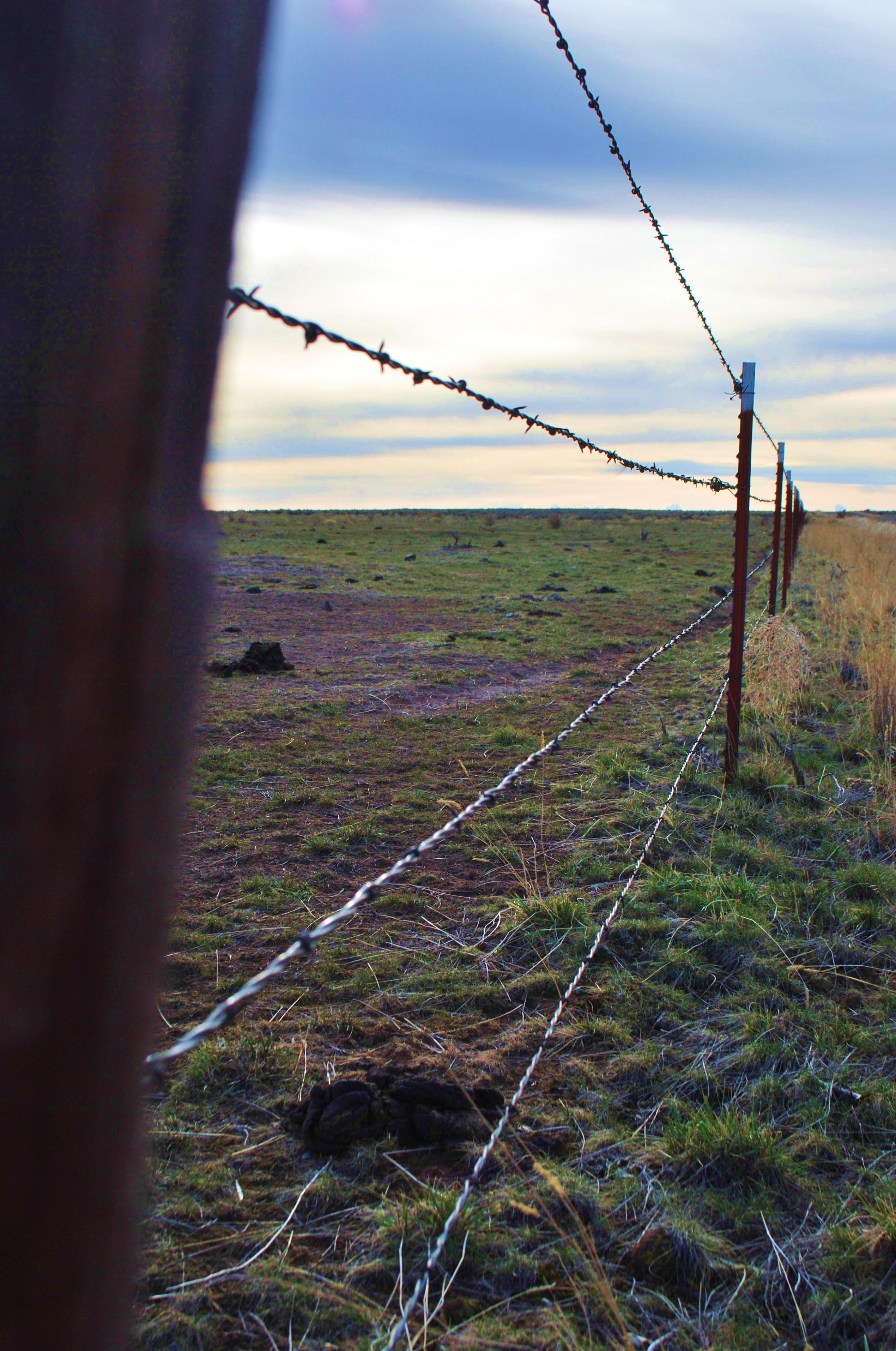
across the fencelines, option 1, mwThe road ahead of me appeared desolate.
A lone mailbox tilted on the side of the road, as if greeting passersby. What stretched ahead were miles and miles of hay fields and grazing land. “It leads to nowhere” many had whispered and turned around as if defeated, making the return trek back to town. Yet what weaved in front of me with every twist of the road and each blade of grass was a tapestry of rural America. The pieces mingled together perfectly, but had often been abandoned in trial.

Nothing came easy in the expansion west. The promise of free land allured many, yet quenched the freedom thirst of many more. Homesteads that are around today are frequently a family lineage of trust: trust that the upcoming generation will enhance or at least continue the dream of the founders. The dream of owning a piece of land and working it to raise a crop and usually a family came with a price: most homesteads hold their own cemeteries as a bleak reminder of the cost.

Cost today is measured in money, something of which homesteaders had little. Their sacrifices came in immeasurable amounts of sweat, blood, time, and tears. Their joy was as immeasurable—a good harvest was shared county wide and a wedding meant a shindig into the wee hours of the night. Celebrations were shared not just by family, but by friends and even slight acquaintances. If you could find the place, you were welcome, but you’d probably be asked to pitch in with chores.

As I sulk over my chores today: mountains of laundry, endless phone calls to make, errands to run… I wonder if we’ve lost rural America. Certainly a full tank of gas and wandering spirit would lead me somewhere remote, but it takes a venture much further out of town than it ever did before and once there seems more ghostly than rural.

Yet it was the sacrifice, the risk-taking, of those brave homesteaders that laid the foundation for agriculture today. Certainly it is growing in productivity, even though the number of places is dropping. Agriculture has set a heart-beat that it will continue for generations to come

The First Cows

Billy had worked on ranches in Nebraska, Wyoming, and Montana, picking up on true ranching culture. Believe it or not, the iconic cowboy is not John Wayne. Cowboys have a sincere heart for the land and the cattle, desiring to improve their herd and their pastures. They live authentically. So authentically that sometimes they look funny and smell bad. Thus when our first cows were purchased, the good old boy network weren’t the only ones laughing.
Every Monday morning, the sale barn comes to life. Behind the sale building are the stockyards where cattle await a new home. One can peruse the pens prior to the sale to get a good look at what will be auctioned off. The pens vary from larger loads of cattle needing to be dispersed, to a lone cow or two just being culled from the herd. Many times there are reasons why ranchers are selling these cows: they aren’t good mommas, they’re funny colored, they’re broken-mouthed (really old), they’re ornery, they’re lame, etc. Sometimes it can be as simple as they calve off-season from the ranchers expected calving season.
Billy stepped inside the office on a chilly winter morning. Awaiting his turn to register for a buyer’s card, he looked around him. Children scampered around the indoor arena or sat eating on the bleachers. The aroma of horses and cattle hung in the air. As he stepped up to the desk, several people glanced in his direction. He received his buyer’s card and took a seat.
Having looked over the pens earlier, Billy knew what cows he wanted. He also knew which ones he could afford. He sat waiting as beautiful two and three year old cows went for more than he had in his checkbook. As some older, but still viable cattle came through, Billy’s buyer’s ticket went up. An ugly grey, but younger cow came through…again he bid and won.
By the end of the sale he had an affordable, but scraggly bunch of cows.
A mature rancher came over and asked where he was working and wondered where he was taking the cows.
“I’m an appraiser right now sir, but I’ve been a cowboy and now I’m buying my first cows. They may be a motley crew, but everyone has to start somewhere, right?” Billy introduced himself and the rancher wished him luck and walked away.
Billy laughed at himself, but held his resolve as he made a couple trips with our eighteen-foot horse trailer to haul the cows to our leased pasture.
Surrounded by established farms and ranches, our little herd looked like a joke. But a Black Angus bull’s genes are dominant in comparison to the recessive genes of those old, ugly girls and our first calves were Black Angus babies. Not only that, but because they were older, they had no trouble calving and were great mothers.
We had known what we wanted in trying to build our own herd, but that first calving season, we really fell in love. We fell in love with the amazement of new life, the beauty of a pasture in the springtime, and the thrill of owning our own cattle—as small as the herd was. There is something honest and worthy in caring for animals and the land. Even though we knew it would be hard work, the simplicity of the lifestyle was worth pursuing. We loved having the cows and over time it’s grown…not just in size, but respectability. The cows aren’t as shaggy as the first bunch, but we sure appreciate the beginners.

Cowboy Daddy


cows, Billy B-Day, Katie B-Day 090This post is also a published article, but it was so much fun to write, I had to share.

Cowboy Daddy

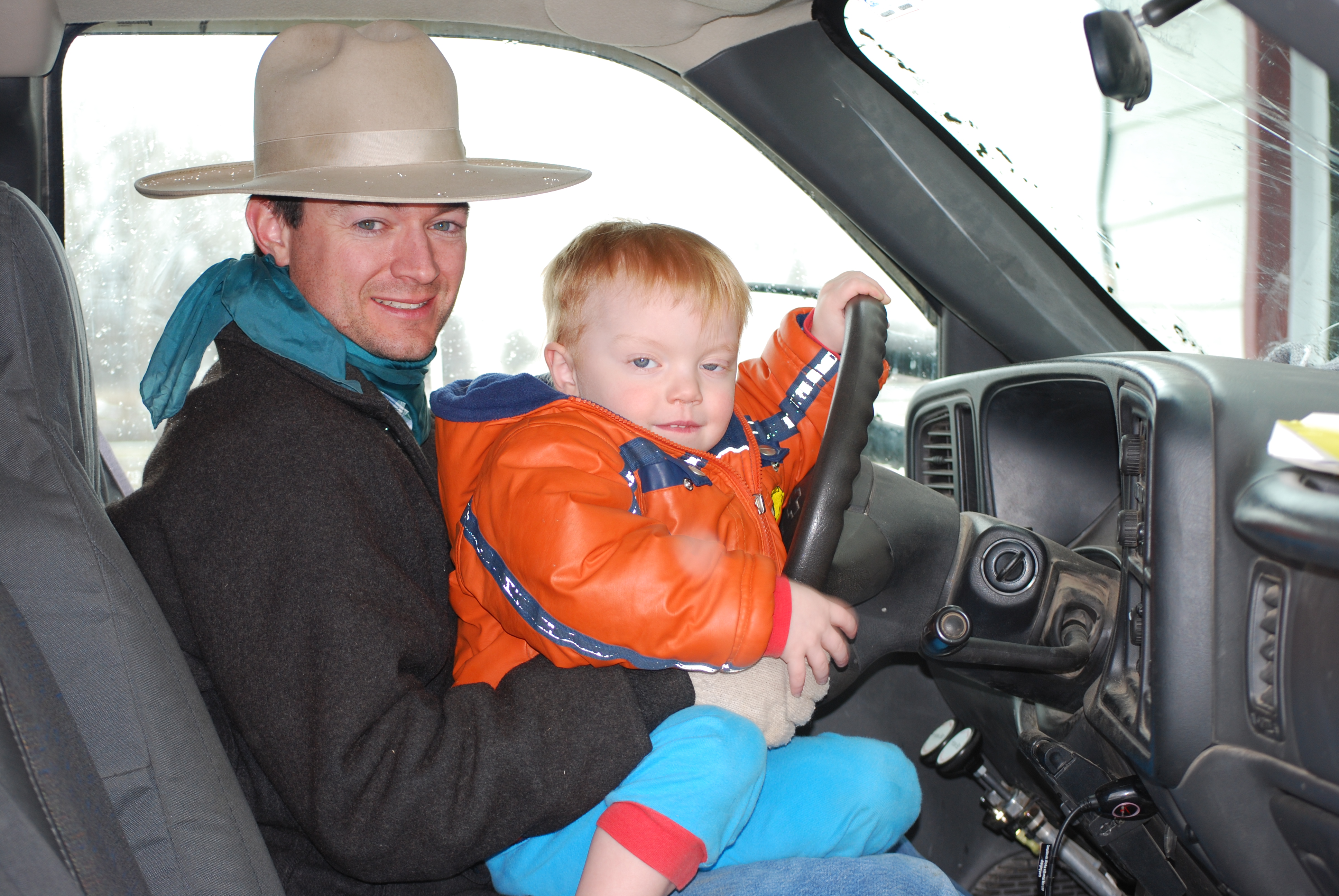
Perhaps it’s the bawl of a new calf. Or it could be that overprotective mother cow. (Her calf’s ID is not a tag, but a crisp new rope.) Maybe its heifers that always seem to calve at night….But when calving season hits, so do memories of impending parenthood. For it was roughly eight years ago when my husband and I found out it wasn’t just the cows who were going to experience the miracle of birth.

“Are you sure?” The brim of my husband’s hat dropped with his jaw.

“I had a blood test.”

“That sure huh?” He began wringing his hands.

We were pretty young. I was told my chances of having children were slim to none. We were shocked, yet truly overjoyed by our blessing.

With the news of our pregnancy coming on the eve of calving season, my cowboy found himself in “baby mode.” He quickly whipped out his cattle gestation calendar and reported to me my due date. (What do you mean there’s a gestation difference?) He flailed his arms and spouted phrases like, just before weaning time, not during haying season, and maybe during a storm or full moon. He quipped that he would know just what to do because he’d helped many animals in my condition. It never occurred to him that I might not like being compared to a cow. I gently reminded him I was not some heifer. That’s when he put away his weight expectancy chart.

Pregnancy does funny things to a woman. Those hay slivers that I continually brushed out of our bed began to irritate me. Anything but hamburgers made me gag. And cow manure on clothing—a fact of life—was not allowed within fifty feet of the house. “Don’t even think about kissing me until you’ve hosed off and stripped in the yard,” I found myself hollering.

It goes without saying that pregnancy changes a woman, but it also changes a man. It certainly changes the size of his wallet. All of the things that are needed for a child add up: the four door pickup, the tractor with the enclosed, air conditioned cab, and the tack.

With tack catalogues strewn across the kitchen table, my hubby could hardly contain his excitement. “What kind of kid’s saddle should I get?”

“Well, the baby’s the size of a bean right now, so I’d go with something small. Let’s not get carried away.”

Yet what first time parents don’t get carried away? At our initial doctor’s appointment my husband came with spurs on and his head cocked like a rooster. An early ultrasound was included, so my cowboy told me what to expect because he’d done ultrasounds for preg checking.

As the doctor performed the ultrasound, he asked, “Are you feeling okay?”

My husband replied, “I’m a little tired.”

Intuition told me the doctor was thoroughly impressed with my man, especially when the ultrasound procedure also included a complimentary bovine narrative. My cowboy actually went in to a mini-lecture on the similarities of my reproductive system and a cow’s. Maybe we could’ve saved money at Trans-Ova, the local cattle embryonic center.

Once my belly began to bulge, so did my man’s ego. Why read baby books when he’d seen a million bovine births? It wouldn’t be that different…would it?

One “difference” came when the baby began kicking. My husband put his hand on my belly expecting to feel a small tap and was blown away when the baby actually moved his hand with a forceful little blow. This was the first time I heard him scream like a little girl.

The second scream occurred in Lamaze class. It was not the videos that made him holler. No, it was another forceful blow—this time by another expectant mother who didn’t tolerate bovine comparisons very well. Needless to say, we didn’t make any lifelong friends there. The calf-pulling conversation didn’t help.

When labor did begin, I was in denial. It was early. My husband convinced me to go to the hospital because I was “walking around like a cow with my tail up.” I promised to go, if he promised not to say that in the delivery room. When we arrived at the hospital and labor was confirmed, my husband obliged, and explained he knew what was happening because he had “seen it in his field.”

When our daughter arrived, cowboy instincts let loose and he nearly fainted. The man can castrate a steer, pull a calf, and inspect afterbirth….but a human umbilical cord made him woozy! All of his jitters passed away though when our beautiful girl was placed in his arms.

Pride has been taken to a whole new level from this time forward. Stories of tagging, penning, and roping will always make a cowboy beam, but a child is like all of these tales and then some. Put some cowboy daddies together and they can talk!

“Why just last week my six-year-old daughter drove the truck while I forked off hay.”

“Oh yah, well my five-year-old won first prize at the mutton busting.”

“That’s nothing. My two-year-old roped a steer on his first try, blindfolded.”

Even with their stories though, cowboys do make great fathers. They help their kids learn about life via the ranch. They teach them to make hay forts. They encourage them to open gates. The only thing that continues to puzzle me is this: How can a cowboy be immune to the stench of manure, stick his hands in the tightest of places, but changing a diaper induces tears or vomiting?

In the Beginning

old homestead
This originally appeared as a feature article in Range magazine, but I’m posting it because it shares so much of my heart.

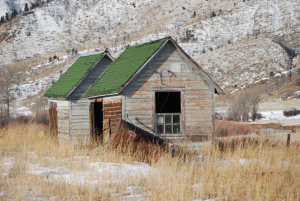
The original farmstead settles into the hillside as easily as the sun rises and sets. Some things are just meant to be. The home has been remodeled, but the heritage held there never diminishes. If you stop and look long enough, you can almost picture the horse drawn wagon that brought the family over decades ago; that first rancher exuding hope and desire to carve out a respectable living. Now, in a new millennium, with unprecedented change around us, this ranch stands with pride as a fifth generation continues managing the land and carrying on their agricultural roots. Uneasiness about the future of agriculture gives way to hope with stories of continuing generations.

This picture is familiar for many farmers or ranchers we know. Many of those now ranching carry a rich agricultural background. Each generation has the task of carrying on the family homestead, usually implementing and adding a few new ideas of their own. There is an intricate weaving of lives with those who have carried on their family inheritance. The Smiths have always bordered the Jones’ and helped each other during shipping, branding, and the likes; while the Johnsons always call the Millers when there is pasture available. Ties and tradition runs deep, as well they should. The beauty of a legacy should never be forgotten nor taken for granted.

A legacy usually denotes authenticity because these families have proven themselves capable of the lifestyle and shown concern for agriculture. However, agriculture is continually changing and unfortunately can prove to be a challenge. Many have sold their family place to move on to somewhere more affordable. Others have downsized herds. Still others have taken outside jobs or subdivided to make ends meet. Some simply grow up never to return.

According to the National Agriculture Statistic Survey (NASS) for 2007, 125,000 farms produced 75% of the value of US agriculture production. Small numbers do not always mean small affects. The face of agriculture may be changing, but it is still accomplishing big things, usually on small budgets. In fact, of the 2.2 million farms nationwide, only 1 million even show positive net cash income from farm operation. Yet they keep contributing because they know what they are doing is beneficial. They know our country needs the agricultural heart to beat strong. It was this heart that attracted us to ranching.

You see, our family heritage is rich in other ways than land. Lacking are the fence lines first put up by our great-great grandfathers. Absent is the farmstead first settled during the Homestead Act. Never present are the reminders of generational agriculture; you’ll never hear a favor extended because they knew our granddaddy or recognized our last name.

What does exist is an insatiable desire to begin a new homestead of our own in an age of development and high dollar vacation ranches. Unable to quench our hope of adding some small sliver to a rebirth of agricultural proprieties and keeping rural America alive, we’ve jumped into the arena as first generation ranchers.

We are not the only ones. We’ve seen people start over on their own after the rest of the family decided to sell out. We’ve seen homesteads become too crowded and necessitate new family sprouts. What is happening is hardly an epidemic, but it is worth noting. With the average age of the ag producer rising, many are hopeful that upcoming generations will return to their roots and become ag producers themselves. We too hope that happens, but there are those of us who lack a legacy, yet desire to fill the boots as young ag producers.

For ranchers with fresh roots, challenges loom. Land prices are higher than many of us can try to grasp, so we lease. It is always somewhat of a gamble each year: we need a certain amount of AUM’s for our cattle, but often grazing ground is leased long before we even hear about it. We can’t blame those who have been here long before us; why should they trust us when they don’t know us—or any of our relatives? Agricultural roots are something to be protected and it’s not easy to convince people around you that you take that seriously while simultaneously trying to make a name for yourself.

My husband grew up around ranching to be sure. It was not a family affair, but would-be friends sensed his sincerity and took him under their wings. He spent time on several ranches from Tennessee to Montana before getting dual degrees in Animal Science and Agricultural Business. At that point, I entered the picture as a new bride sharing his passion, and we spent time on different ranches just cowboying, until ranch management became possible. After this, the lure of starting something of our own overcame us. So we took on more schooling, additional jobs, and delved into the world of first generation ranching. Starting out with a whopping ten cows almost as old as we were, we watched as our ten became twenty, then thirty…growing into the ninety we have today.

It isn’t easy though. We watch as the good old boys get leases that would have revolutionized our operation. We understand why, but we are ever hopeful that someone will take note that our scraggly bunch of cows isn’t so scraggly anymore. That after years of comments like, “some boy down the road bought himself a couple cows and thinks he’s gonna be a rancher!” (followed by raucous laughter), it will be noted that we are still here—and growing.

Growth rarely occurs without loss though. My husband has written, “I will never forget the despair I felt one night a few years ago as I sat in the middle of a pasture soaked with the wetness of the newborn calf that died in my arms as I tried like hell to keep him alive. The wind smacked at my face and the headlights of a pickup well past its prime highlighted the snow that was traveling more horizontal than vertical. The headlights passed, leaving me with nothing but the sorrow of a lost life. We were only two years into building a herd of cows, this one calf was 5% of our calf crop for the year. I can think of few places in my life that were as lonely as the calving pasture was that night.”

Sticking it out is hard without support. We’ve been asked why we keep going. Yet isn’t there something in everyone’s life, some dream that feels elusive, yet entirely captivating, that propels us forward? Some hope that we can make a difference? Judging from the success of westward expansion, we aren’t the only ones hoping to find a treasure in rural heritage, we’re just over a century late.

Or are we? In a time of economic downturn, we are all whittling down to only basic necessities. Will this take us back to a time of simplicity? A time where we step back and look at what brought us down this road? Will we recognize the intrinsic thread of agriculture in a nation that once treasured every aspect of its existence?

That’s not to say that agriculture has not received respect, but certainly if the nation realized what a cornerstone it plays in our country’s success, yet how terribly trying, labor intensive, educationally necessary, not to mention how subject to acts of God, would we pay homage to this life giving facet?

Recently I heard a broadcaster commenting on the economic downturn and how the only ones making out in this bust were the farmers. If I could’ve found contact information, I’d have given a rebuttal. They can look at our gross income and be somewhat impressed, but have they tried to buy a tractor, or hay, or fertilizer lately? Do they have any idea what the profit actually equals? Do they know that 60% of all farms report less than $10,000 in the sales of agriculture products? Do they have any idea that 65% of all farmers work off-farm too to supply income for their families?

Extreme effort backs most agricultural enterprises. A forty hour work week would be a vacation. To supplement our endeavor, my husband works as an agricultural land appraiser. Even though our ranch is small, our agricultural heart is strong and we’ve been welcomed in the past few years as members of the agricultural community. Our neighbors now come for branding and shipping, and we do the same for them.

So to go against the tide that says we’re making out like bandits, to go against development, takes guts. It is the hope of a legacy that keeps us wanting to grow. We still only own the land we live on, but so far leases have worked out. We’ve found support and camaraderie in our friends and neighbors. What we hope continues to pulse in us is the beat of the agricultural heart that has carried so many families, so that the three children we now have will be able to say: We’re second generation ranchers. Hopefully our children will understand the sacrifices much the same way so many of the fifth and sixth generation ranchers do. With any luck, they’ll recall fond memories of feeding a bottle calf, lessons of life and death learned only through ranching, and they’ll realize that they are a huge reason we stick it out. And maybe, just maybe, by the time they’re grown, there’ll be a homestead they can come back to, where our family heritage will continue. A place where a new ranch thrives, not because we’re trying to be something we’re not, but because we’re trying to grow into who we were meant to be.